

Linked Data is an approach to representing and publishing information – applying the principles of the web to the challenge of integrating and using data. This is a graph based data structure that supports supports multiple uses of the data including emerging AI and data science tools.
Linked data solves core data problems by ensuring information is connected, interoperable, and future-ready
Linked Data applies the principles of the web to the challenge of integrating and using data.
Some concrete examples
The Environment Agency’s Hydrology Data Explorer & API
- High volume, rich telemetry sensor data, spanning river flow and level data, rainfall and water-quality data from monitoring stations throughout England.
- Epimorphics’ Agora Measurement Store, contains over 5 billion measurement samples while delivering interactive retrieval speeds
- The store combines the power of Linked Data metadata with a cloud-native relational database for the sensor data
- The system drives dynamic maps and data visualizations as well as scalable APIs (See Blog posts)
- We are constantly looking to the future – in early 2004 we worked with EA to explore possibilities of using Large Language Model AI services to respond to natural language queries by users, based on the real-time sensor data (See Blog Post).
See project page for more


HM Land Registry Price Paid Data (PPD) and House Price Index (HPI) websites and APIs
- We designed and have been operating the PPD and HPI web services since 2012
- They provide highly configurable search and reports over 30 years of house price and HPI data and programmatic access to underlying data via APIs
- The SPARQL endpoint and APIs are very widely used by organisations in the housing and financial sectors including major online property websites & portals.
See project pages for more
Food Standards Agency Regulated Products Register
- The Regulated Products Registers are the registers of applications and authorisations for food or animal feed products that require a formal authorization process before it can be legally sold
- We have designed and operated the available online registers from EU Exit.
- Since April 2025, the register is the primary source of information about regulated product applications and ministerial decisions about authorisations – prior to that the primary notification was by legislative statutory instrument.
- We have worked with FSA to rapidly expand the range of food and feed types and associated data models included in the registers, to ensure and enable compliance with the changes in legislative process.
See project page for more

Let’s look at why it’s been chosen
Linked data isn’t just a theoretical idea — it’s been adopted by governments, businesses, and research organisations worldwide. Why? Because it consistently solves the hardest data problems.
Here are the main reasons it’s chosen:

A Solid and Principled Grounding
Linked Data development was led by Tim Berners Lee specifically to solve the hard problems of web scale data iIntegration. It is a mature technology that has stood the test of time and easily adapts to changing needs and contexts
Reusability and Interoperability / Connecting Data Across Silos
Transform your vision into reality with powerful no-code solutions that put you in control of your website with no limitations.
Based on Open Standards
Built on widely adopted W3C standards and web protocols, Linked Data avoids proprietary formats and reduces the risk of vendor lock-in, ensuring long-term accessibility and interoperability
Consistency and Clarity
By using shared vocabularies and identifiers, linked data avoids the confusion of conflicting labels and definitions. This ensures information is consistent and unambiguous, whether used internally or shared externally.
Trust, Quality and Governance
Every item has a resolvable web address you can cite, annotate and explain. Built-in provenance, versions and change histories reduce risk and support robust audit. It’s a framework for standardizing metadata and creating a shared vocabulary across different business domains making governance easier and more transparent
Shares Conceptual DNA with FAIR Principles
Linked Data isn’t just compatible with FAIR, it’s arguably the most complete, standards-based approach for making data FAIR by design.
Supporting Innovation and Insight
By making connections visible, linked data enables new insights and applications. From combining environmental datasets to powering smarter services, it helps organisations move beyond isolated information to knowledge they can act on.
Future Proofing
Data needs change over time. Linked data is agile, flexible and extensible — new relationships and attributes can be added without breaking existing systems. This makes it an future-ready approach, in contrast to rigid legacy models.
AI-Ready Graph-based Data
Clear semantics, standardised query and simple graph-based formats make the data discoverable and useful for modern analytics and LLMs and other kinds of AI.

Want to understand Linked Data in more detail?
What is Linked Data?
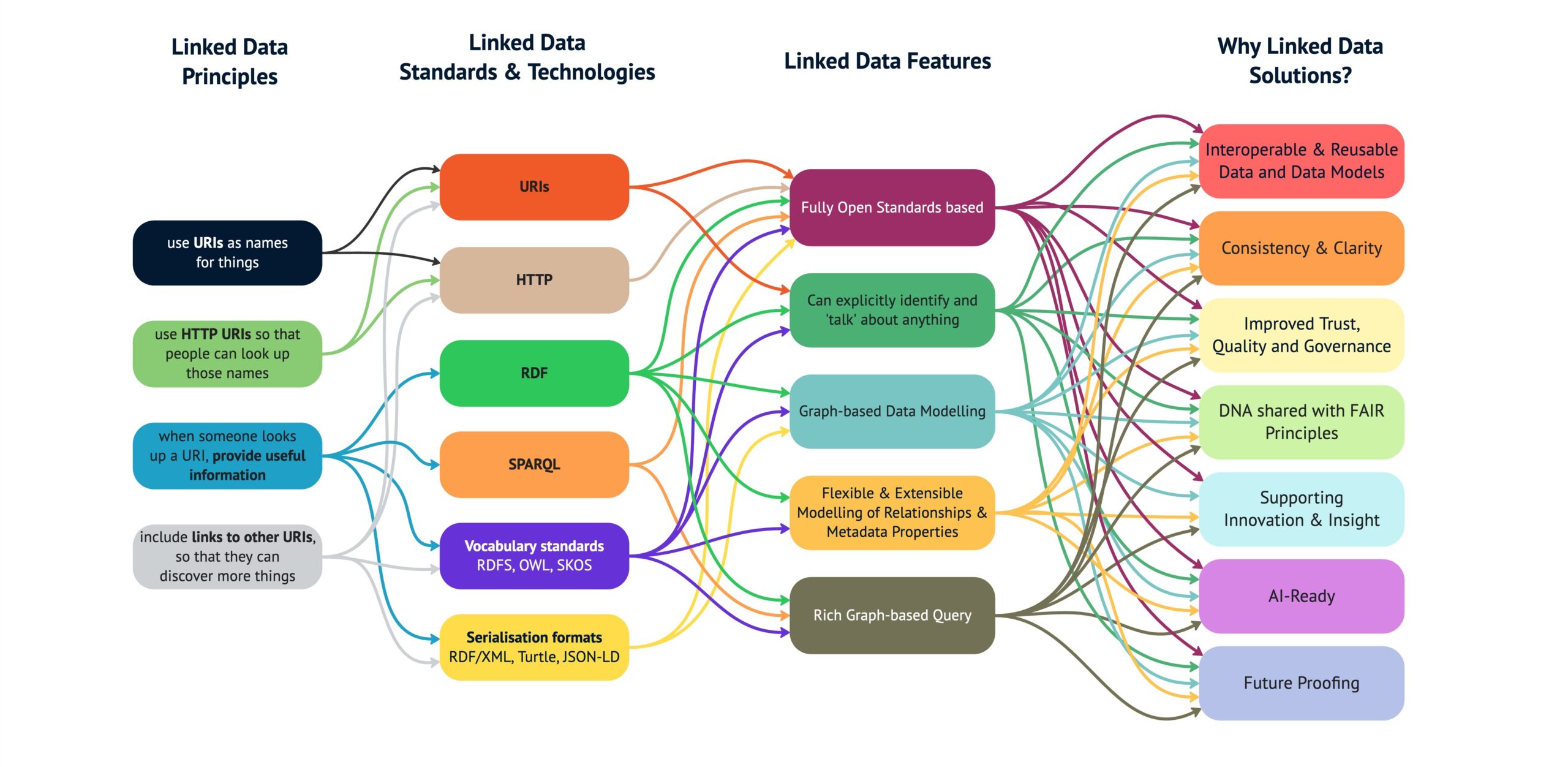
The figure illustrates why linked data solutions are effective. The key principles for solving some of the hardest data integration problems was the basis for creating a set of Open W3C Standards that provided the features needed to build effective, extensible and sustainable data-based solutions.
Talk to us about how we can bring the benefits of linked data to your organisation